Government of IndiaGOVERNMENT OF INDIA
Skip to main content
English language
Accessibility
Accessibility Tools
Color Adjustment
Text Size
Navigation Adjustment
Screen Reader iconScreen Reader
MyGov Twitter
MyGov Facebook
MyGov Youtube
MyGov Instagram
MyGov Linkedin
MyGov Whatsapp
Meri Sarkar Logo

Recent Searches

      Close

      Get Involved

      • Groups
      • Do/Tasks
      • Discuss
      • Poll/Survey
      • Blog
      • Talk
      • Quiz
      • MG Prime
      • Campaigns
      • Pledge
      • Podcast
      • Media
      • Periodicals

      MyGov States

      • Andaman & Nicobar Islands
      • Arunachal Pradesh
      • Assam
      • Chandigarh
      • Chhattisgarh
      • Dadra and Nagar Haveli and Daman and Diu
      • Goa
      • Gujarat
      • Haryana
      • Himachal Pradesh
      • Jammu And Kashmir
      • Jharkhand
      • Karnataka
      • Ladakh
      • Madhya Pradesh
      • Maharashtra
      • Manipur
      • Mizoram
      • Nagaland
      • Rajasthan
      • Tamil Nadu
      • Tripura
      • Uttar Pradesh
      • Uttarakhand
      • Lakshadweep
      • Odisha
      • Puducherry
      • Sikkim

      Microsites

      • Blog
      • Campus
      • Innovate India
      • Pledge
      • Quiz
      • Saathi
      • Self4Society
      • Transforming India
      • PM Events

      Get to Know

      • MyGov: An Overview
      • Associate with MyGov
      • Work at MyGov
      • Circulars
      • Pulse Newsletter
      • Tenders
      • Weekly Newsletter
      • Meity Dashboard
      • Sectors
      • Skills
      • Area of Interest
      • Age Group
      • National Events
      • Archive Sites

      Help/Feedback

      • Contact Us
      • FAQ
      • Feedback
      • Help
      • Link To Us
      • Public Grievance
      • Site Map
      • Terms & Conditions
      • Usage of Aadhaar
      • Web Information Manager
      • ICC
      • MyGov Social
      • Points and Badges
      • Website Policies
      user-profile
      Together, Let's Engage In Good Governance 
      Login/Register
      1. Home
      2. Discuss
      3. Inviting Ideas for Next Phase of Rural Sanitation
      Facebook X
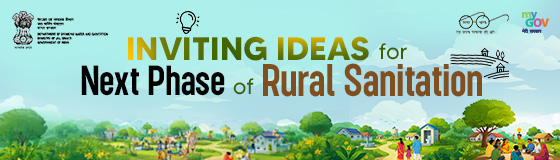
      Inviting Ideas for Next Phase of Rural Sanitation
      Start Date 01/08/2026 - 11:49
      End Date 02/10/2026 - 23:45
      Time zone: IST (GMT +5.30 Hrs)
      Login to Participate
      Sector:
      Water & Sanitation
      Created : 1/08/2026
      667
      Total Comments
      485
      Users Participated

      In the last 12 years, SBM(G) has evolved from a sanitation programme into a nationwide movement that has improved public health, enhanced dignity of women, empowered communities and promoted sustainable rural development. Building on the achievement of Open Defecation Free (ODF) status, SBM(G) 2.0 has expanded its focus to sustaining sanitation outcomes through interventions such as Individual Household Latrines (IHHLs), Community Sanitary Complexes (CSCs), Solid and Liquid Waste Management, Plastic Waste Management, Faecal Sludge Management, GOBARdhan, Information, Education and Communication (IEC) and Capacity Building. The current phase of the Mission is scheduled to conclude in March 2027.

      As the Department prepares the roadmap for the next phase of rural sanitation, it seeks ideas from citizens to sustain and strengthen the gains achieved under SBM(G) while addressing emerging challenges related to waste management, resource recovery, environmental sustainability, Operation & Maintenance (O&M) and long-term community ownership of assets and outcomes. Innovative, practical and scalable solutions are required to enhance sanitation service delivery, strengthen waste management systems, promote behavioural change and accelerate the transition towards a circular waste-to-wealth economy. Given that the diversities of rural areas from urban cities, suggestions and ideas, specific to rural scenarios will be highly appreciated. Along with these, with peri-urban areas / villages also growing fast and having characteristics of urban centers, solutions specific for such areas are also being sought.

      The success of SBM(G) has been driven by the spirit of Jan Bhagidari (People's Participation). Citizens, Gram Panchayats, SHGs, youth, Swachhagrahis and other stakeholders have been at the forefront of transforming rural sanitation and their continued participation will remain critical for sustaining these achievements. 

      Accordingly, the Department of Drinking Water and Sanitation (DDWS), Ministry of Jal Shakti in collaboration with MyGov, invites citizens, youth, Gram Panchayats, SHGs, academic and research institutions, development partners and other stakeholders to share their suggestions and ideas for the next phase of rural sanitation programme on the following:

      1. Areas to be taken up (including existing areas where gaps may be remaining)
      2. New technological interventions for SWM, GWM, FSM.
      3. Rural Sanitation 
      4. Solutions for treating pollution in small nallahs/rivulets discharging into rivers in rural areas.
      5. Adoption of solutions based on traditional knowledge and ancient wisdom in new settings for rural India. 
      6. Any other area related to the programme.

      The suggestions received will help and guide the next phase of SBM(G) and contribute to building cleaner, healthier and environmentally sustainable villages that will be strong contributors for achieving the goal of Viksit Bharat@2047.

      Participation Guidelines 

      1. All Citizens, youth (including students), Gram Panchayats & SHGs, academic and research institutions, development partners, NGOs and other stakeholders are invited to contribute ideas for shaping the next phase of rural sanitation and solid-liquid waste management under Swachh Bharat Mission (Grameen).
      2. For detailed information about SBM(G) Phase II, applicants may visit the SBM(G) Phase II operational guidelines available on website of the Department (https://swachhbharatmission.ddws.gov.in). The guidelines can also be assessed through: https://swachhbharatmission.ddws.gov.in/sites/default/files/Guidelines/SBMG%20Phase-II%20Operational%20Guidelines.pdf 
      3. Suggestions may be submitted on any of the major components of SBM(G), including Individual Household Latrines (IHHLs), Community Sanitary Complexes (CSCs), Solid Waste Management, Liquid Waste Management, Plastic Waste Management, GOBARdhan, Faecal Sludge Management, Information, Education and Communication (IEC) and Capacity Building. Global best practices forming the bases of solution, may also duly mentioned and referred.
      4. Participants are encouraged to propose innovative, technology-driven, scientific, managerial, practical, feasible and scalable solutions to address rural sanitation challenges and strengthen long-term sustainability.
      5. Suggestions should focus on supporting the Department of Drinking Water and Sanitation (DDWS), Ministry of Jal Shakti, in developing the roadmap for the next phase of rural sanitation for India.
      6. Participants are required to register on the MyGov platform and submit their suggestions through the prescribed online form.

      TARACHANDGUPTA_13
      TARACHANDGUPTA_13
      2 months 2 weeks ago

      Respected Sir,Pranam.A lots have changed now.School up to 12th standard,Electricity,Road connectivity,Aganwadi,Subcentre,Panchayat etc.Negatives are Evils of Tobacoo,Liquor,Mobile use,Plastics and other single use disposables etc.We have SHG and nos of Govt.employees in rural areas now,some rural areas are semi urban.All Govt.employees shall be involved in this task for overall development of villages & innovative & sustainable ways by community participation & financial incentives also.Regards

      TARACHANDGUPTA_13
      TARACHANDGUPTA_13
      2 months 2 weeks ago

      Respected Sir,Pranam.I had my brought up in village up to 25 years.No electricity,no road connectivity,water from open wells one km. away.No to liquor,drugs,Tobacoo etc.it was 40 years before.No use of plastic,clothes bags to bring articles from market like Rashan sugar etc.Most solid wastes were segregated& biodegradable.All lands and water bodies are free from plastic,only problem of open defection,it has resolved to some extent but poor quality construction & maintenance are major issues.

      PayalAgarwal_84
      PayalAgarwal_84
      2 months 2 weeks ago

      Kapde dhone ke bad sare Pani ko ham wapas istemal kar sakte hain ek drum ya cement ki Tanki mein niche gitti bichhaye uske upar charcoal ki ek parat rakhen aur uske upar retir vidyalay ismein jab ham kapde dhone ke uprant Pani dalenge dudh chhan jaega saaf ho jaega aur ham aise hamare baudh Shala mein kheton mein kam mein le sakte hain Jahan mitti bhi sukhegi nahin agar ham is prakriya ko nahin apnate hain aur sidha Pani dalte Hain to mitti Sukh jaati hai kyunki sirf sabun mein chemical hota hai vahi agar ham barish ke Pani ko niche tankiyon mein ekattha Karen to ham peene ke liye nahin parantu kapde dhone ke liye kheton mein gadiyan dhone ke liye gharelu kamon mein nikalne wale Pani ko bhi ham hamare garden mein upyog kar sakte hain ki ham usko yog upbhog kar sakte hain under ground tank mein ekatthe hone wale Pani ko bahane ke bachaye ham kheton ki taraf ya garden ki taraf bhi pipe ke jarie upyog kar sakte hain barsat ke Pani ko ham Pi nahin sakte to kya kapde dhona gadiyan dhona saa

      Athikala prasad rao
      AVVSSNV Prasad Rao
      2 months 2 weeks ago

      further to my comments awareness shall be created about wet and dry waste management. in villages waste managements centers are existed but no one takes responsibility to manage them . Hence one responsible person/ agency shall be appointed to effectively manage centers. If centralised waste management centers are existed , then proper transport of garbage shall be ensured.

      Kotra Aditya
      KOTRA ADITYA
      2 months 2 weeks ago

      Future ready steps like plastic waste recycling to be done in villages before entering into the water bodies. Only 10% of solid plastic waste is recyclable in villages in India. Pollution of water bodies with plastic waste is a big problem. Plastic waste in water bodies causing diseases to people and animals. Animal husbandry loss is a significant problem in rural India with plastic in stomach of animals.

      Aqsa_557
      Aqsa_557
      2 months 2 weeks ago

      Empower Self-Help Groups to run decentralized units for Plastic Waste Management, GOBARdhan, and Faecal Sludge Management in every Gram Panchayat. Plastic can be converted to road tiles/paver blocks, GOBAR to biogas/CNG, and FSM to organic fertilizer. Revenue generated will fund O&M of IHHLs and CSCs. Train Swachhagrahis via mobile app for IEC. This ensures long-term community ownership, local jobs for women, and financial sustainability beyond government funds. To treat pollution in small nallahs/rivulets before they enter rivers, implement low-cost Constructed Wetlands combined with traditional knowledge like Jeevamrut, neem, and vetiver grass for bio-remediation. Mandate greywater treatment pits with every new CSC in peri-urban villages. Form a Panchayat O&M committee with youth volunteers for monthly monitoring. This is cheaper than STPs and suited for rural terra

      sukrititrivedi_2
      sukriti trivedi
      2 months 2 weeks ago

      High-performing Gram Panchayats can mentor nearby Panchayats on waste collection, CSC management, composting, greywater treatment and community mobilisation. Practical peer learning can often be faster than conventional training.

      sukrititrivedi_2
      sukriti trivedi
      2 months 2 weeks ago

      Before constructing new sanitation facilities, Panchayats should map population density, existing assets, drainage, water availability, soil conditions and future growth. This can prevent poorly located toilets, treatment units and drains that later become difficult to maintain.Village ponds and streams should have appropriate vegetation or buffer zones wherever feasible. These buffers can reduce direct entry of sediment and pollutants while improving biodiversity and the appearance of public spaces.

      sukrititrivedi_2
      sukriti trivedi
      2 months 2 weeks ago

      Greywater from kitchens and bathrooms should be channelled through suitable low-cost treatment systems and reused for trees, horticulture and other safe applications. Villages can develop green belts, community gardens and plantations using treated water, converting a sanitation problem into an environmental benefit.

      ANKUSHJANARDHANMANNE
      ANKUSHJANARDHANMANNE
      2 months 2 weeks ago

      कचरा बँक गावातील प्लास्टिक, कागद, लोखंड, काच इत्यादी पुनर्वापर करता येणारा कचरा एकत्रित करण्यासाठी “कचरा बँक” सुरू करता येईल. ग्रामस्थांनी घरातील वर्गीकृत कचरा ग्रामपंचायतीने निश्चित केलेल्या कचरा बँक केंद्रावर जमा करावा. जमा केलेल्या कचऱ्याचे वजन करून त्याची नोंद संबंधित कुटुंबाच्या नावावर करण्यात यावी. कचऱ्याच्या वजनानुसार ग्रामस्थांना “स्वच्छता गुण” देण्यात यावेत. हे गुण ठराविक प्रमाणात जमा झाल्यानंतर त्याबदल्यात स्वच्छता साहित्य, रोपे, कापडी पिशव्या, घरगुती उपयोगाच्या वस्तू किंवा ठराविक रोख प्रोत्साहन देता येईल. या कचऱ्याची विक्री अधिकृत पुनर्वापर करणाऱ्या संस्थांना करून त्यातून मिळणारा निधी पुन्हा गावातील स्वच्छता उपक्रमांसाठी वापरता येईल. त्यामुळे कचरा रस्त्यावर किंवा नाल्यात टाकण्याऐवजी ग्रामस्थांना तो जमा करण्यासाठी प्रोत्साहन मिळेल. “कचरा म्हणजे समस्या नसून संसाधन आहे” ही भावना गावामध्ये निर्माण होईल.

      • First page « First
      • Previous page ‹ Previous
      • …
      • Page 36
      • Page 37
      • Page 38
      • Page 39
      • Current page 40
      • Page 41
      • Page 42
      • Page 43
      • Page 44
      • …
      • Next page Next ›
      • Last page Last »
      Please Log In to submit a comment.
      Get Involved
      • Groups
      • Do/Tasks
      • Discuss
      • Blog
      • Poll/Survey
      • Talk
      • Quiz
      • MG Prime
      • Campaigns
      • Pledge
      • Podcast
      • Media
      • Periodicals
      Get to Know
      • MyGov: An Overview
      • Associate with MyGov
      • Work at MyGov
      • Circulars
      • Pulse Newsletter
      • Tenders
      • Weekly Newsletter
      • MeitY Dashboard
      • Sectors
      • Skills
      • Area of Interest
      • Age Group
      • National Events
      • Archive Sites
      Help & Support
      • Contact Us
      • FAQ
      • Feedback
      • Help
      • Link To Us
      • Public Grievance
      • Site Map
      • Terms & Conditions
      • Usage of Aadhaar
      • Web Information Manager
      • ICC
      • MyGov Social
      • Points and Badges
      • Website Policies
      Useful Links
      • MyGov Quiz MyGov Quiz
      • Transforming India Transforming India
      • MyGov Innovation MyGov Innovation
      • MyGov Pledge MyGov Pledge
      • MyGov Blog MyGov Blog
      • Self4Society Self4Society
      • Campus Program Campus Program
      • MyGov Saathi Saathi
      Follow us
      Twitter Twitter 33.11 + Lakh Followers Facebook Facebook 15.14 + Lakh Followers Instagram Instagram 30.73 + Lakh Followers YouTube YouTube 7.43 + Lakh Subscribers LinkedIn LinkedIn 1.63 + Lakh Followers Messenger Messenger 1.60 + Lakh Followers WhatsApp WhatsApp 910.05 + Lakh Followers DailyHunt DailyHunt 7.2 + K Followers Public Public 85.5 + K Followers ShareChat ShareChat 82.22K Followers Snapchat Snapchat View All
      QR Code

      Download the MyGov Mobile App Join us in building a New India on the move.

      App Store Play Store
      NIC logo

      © Content owned, updated and maintained by the MyGov Cell. This website belongs to MyGov, Ministry of Electronics & Information Technology, Government of India.
      Platform is designed, developed and hosted by National Informatics Centre.

      CQW - MyGov certificateCertified Quality Website
      • Meity
      • Digital India
      • National Portal of India
      • Data Portal

      Copyright © MyGov 2014

      mygov-1 - Last Updated: October 30, 2026
      Top
      This website uses cookies to provide a better user experience.
      By clicking accept, you agree to the policies outlined in the Cookie Settings.