Home | MyGov

Accessibility
Accessibility Tools
Color Adjustment
Text Size
Navigation Adjustment
Screen Reader iconScreen Reader

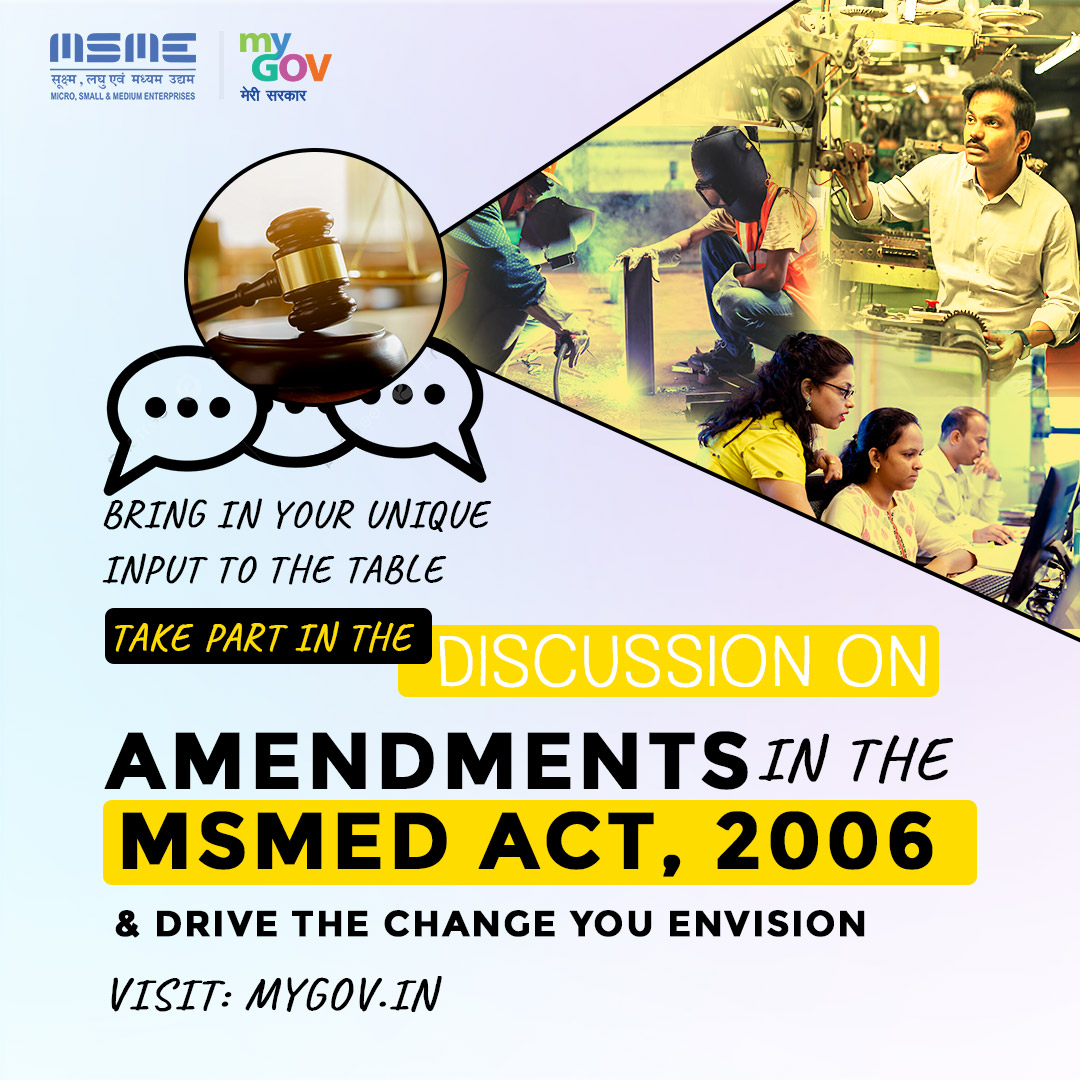
Discussion on Amendments in the MSMED Act 2006

Discussion on Amendments in the MSMED Act 2006
Start Date :
Jul 05, 2024
Last Date :
Aug 05, 2024
23:45 PM IST (GMT +5.30 Hrs)
Submission Closed

The Ministry of MSME is in the process of amending the MSMED Act, 2006. In this regard, this Ministry had consulted various central Ministries/Department/State Govt./Industry ...

The Ministry of MSME is in the process of amending the MSMED Act, 2006. In this regard, this Ministry had consulted various central Ministries/Department/State Govt./Industry Associations/other stakeholders & general public.

Based on the consultations and written inputs received from various stakeholders, the amendments proposed in the MSMED Act, 2006 are based on the following four key pillars:

A) Enhancing inclusivity and broad-basing the scope of the Act;
B) Future-proofing the Act;
C) Improving co-ordination under the Act;
D) Enhancing the ease of business in the ecosystem;

A) Enhancing Inclusivity and Broad-basing the scope of the Act
• Accord statutory status to Udyam registration for availing benefits under the Act.
• Provision for credit guarantee coverage to Micro and Small Enterprises by Government.
• Enabling provisions to address issues of credit gap; shortage of working capital; ensure adequate, affordable, and timely finance to enterprises; minimize the incidence of financial stress among enterprises; and leverage new and emerging platforms and technologies such as the Trade Receivables Discounting System, Account Aggregator Framework, etc.
• Provision for targeted mechanisms for capacity building of women, members of SC and ST, and rural artisans and craftspeople and provisions for market access, financial and digital literacy.
• Inclusion of cottage, village, and coir industries as rural artisans and craftspeople in the MSME classification scheme, to promote rural industries and enterprises.
• Inclusion of Medium Enterprises in the dispute resolution framework

B) Future-proofing the Act
• Strengthen provisions for technological upgradation and green technology to enhance productivity, quality, and competitiveness.
• Enabling provisions for the adoption of energy-efficient, sustainable technologies by MSME.
• Designation of a Green Fund to support the energy transition of MSME and integration in the global value chain.
• Addressing industrial obsolescence among enterprises.
• Promoting technological upgradation and research and development among enterprises.
• Encouraging the adoption of sustainable technology solutions by enterprises.

C) Improving coordination
• Streamline the structure, working, and functions of the National Board and the Advisory Committee to make them lean, efficient, and responsive to the requirements of MSME, and strengthen the monitoring and evaluation mechanism.
• Provision to set up an adequate number of Facilitation Councils in States for better access to MSMEs, along with an incentive structure to promote competition and good performance among them.
• The composition of the Facilitation Councils may be prescribed by the State Government.

D) Enhancing Ease of Business in the Ecosystem
• Provisions for the decriminalisation of offences by converting criminal fines into civil penalties.
• Simplification of regulatory clearance mechanism and procedure for establishment and management of MSME by making suitable provisions in the Rulemaking powers of the appropriate Government.
• Creating and encouraging the adoption of digital solutions to improve transparency and foster a culture of accountability
• Make the adjudication process simpler and speedier, aligning it with the alternative dispute resolution framework and online dispute redressal.

Please Click Here to Read more.

Reset
Showing 768 Submission(s)
Swetha Kannan
Swetha Kannan 1 year 11 months ago
4. As per my experience, I can see many people unaware of benefit schemes who is doing state government or central government etc. This awareness can help to understand people better. Government can ensure people it reaches properly, Whether central government doing or state government doing. So that people will get clarity. I can see especially unauthorised works, home maids are not aware of the benefits who is doing. What is there for them. They have the query limf whom we have to approach etc. So awareness or knowledge sharing is key for progress.
Swetha Kannan
Swetha Kannan 1 year 11 months ago
3. In India itself many people does not aware of Indias diversified products. Like clothe available in each state is different, different products like mango, banana, veg , food items etc. That knowledge sharing, promoting via social media or tv will help to understand better. For example if we want to export Mysore silk , we can sat it is one of the Karnataka states special cloth type etc. Many unaware of diversified products, one district one products etc.
Swetha Kannan
Swetha Kannan 1 year 11 months ago
2. Basic soft skills ,quality training or six Sigma training for micro,small , medium industries will help to achieve quality products over the period of time. In our country many youngsters are there, college freshers it is difficult to start ups. Or some entrepreneurship training development courses will help them. So working with less salary gaining experience also some people does. Like internships. Etc. We can create awareness to create startups,basic experience etc
Swetha Kannan
Swetha Kannan 1 year 11 months ago
Some suggestions 1. While giving concession for startup , we can encourage eco products like avoiding plastics bags, giving cloth bags or paper bags or other material bags etc will help to environment friendly. Similarly eco start up can connect with other startup or tie ups , so that both the products can promote. The list for start ups which can be general can be shared so that start ups can benefits each other.
Rushikesh Ugale
Rushikesh Ugale 1 year 11 months ago
can we make a provision where NPA period could be raised beyond 90 days to 120 days atleast for MSME. It will give them enough room for improving business activity.
KACHHAD NAVNITKUMAR BAVANJIBHAI
KACHHAD NAVNITKUMAR BAVANJIBHAI 1 year 11 months ago
every city manufacturing and industrial small scale production industry cluster should be created. to boost city economy and smart City project development futuristic approach should be taken how the futuristic roads, water management , heavy rain fall natural calamities all government systems should be updated. cities should be beautiful and with best World class infrastructure
KACHHAD NAVNITKUMAR BAVANJIBHAI
KACHHAD NAVNITKUMAR BAVANJIBHAI 1 year 11 months ago
is the most recent phase, which the World Economic Forum claims has no precedence in history, is evolving exponentially, and has the potential to completely revolutionize all production, management, and governance systems in every nation. Rapid, nonlinear change is made possible by exponential technologies thanks to major advancements (and lower prices) in areas like computing power, bandwidth, and data storage.
KACHHAD NAVNITKUMAR BAVANJIBHAI
KACHHAD NAVNITKUMAR BAVANJIBHAI 1 year 11 months ago
Artificial intelligence, additive manufacturing, and bioengineering are examples of new technologies that have been made possible by the rapid rise in computing capability and the sharp decline in computing prices. Although it is well recognised that the youthful population can adapt to new technological advancements, it is crucial to remember that young people do not constitute a homogenous group. Accessibility, knowledge, motivation, and other factors all play a role in how successfully these new technologies are used. The percentage of youngsters who are not in employment, education, or training (NEET) has gone up for both men and women, going from 13.1% in 2019 to 15.3% in 2020 for males an
KACHHAD NAVNITKUMAR BAVANJIBHAI
KACHHAD NAVNITKUMAR BAVANJIBHAI 1 year 11 months ago
The topic "Future of Work: Industry 4.0, Innovation & 21st Century Skills" intends to guide new objectives that address cutting-edge technology and creative thinking, especially from the young generation who will have a huge impact on the future. To make sure that the policy agendas on these issues also include youth-centric concerns, Y20 India has taken the lead in promoting this concept to young people from all over the world
KACHHAD NAVNITKUMAR BAVANJIBHAI
KACHHAD NAVNITKUMAR BAVANJIBHAI 1 year 11 months ago
Artificial intelligence, additive manufacturing, and bioengineering are examples of new technologies that have been made possible by the rapid rise in computing capability and the sharp decline in computing prices. Although it is well recognised that the youthful population can adapt to new technological advancements, it is crucial to remember that young people do not constitute a homogenous group. Accessibility, knowledge, motivation, and other factors all play a role in how successfully these new technologies are used. The percentage of youngsters who are not in employment, education, or training (NEET) has gone up for both men and women, going from 13.1% in 2019 to 15.3% in 2020 for males and