Section 67 of Railway act prescribes that:-
1. No person shall take with him on a railway, or require a railway administration to carry such dangerous or offensive goods, as may be prescribed, except in accordance with the provisions of this section.
2. Non person shall take with him in a railway the goods referred to in sub-section (1) unless he gives a notice in writing of their dangerous or offensive nature to the railway servant authorized in this behalf.
3. No person shall entrust the goods referred to in sub-section (1) to a railway servant authorized in this behalf for carriage unless he distinctly marks on the outside of the package containing such goods their dangerous or offensive nature and gives a notice in writing of their dangerous or offensive nature to such railway servant.
4. If any railway servant has reason to believe that goods contained in a package are dangerous or offensive and notice as required under sub-section (2) or sub-section(3), as the case may be, in respect of such goods is not given, he may cause such package to be opened for the purpose of ascertaining its contents.
5. Notwithstanding anything contained in this section, any railway servant may refuse to accept any dangerous or offensive goods for carriage or stop, in transit, such goods or cause the same to be removed, as the case may be, if he has reason to believe that the provisions of this section for such carriage are not compiled with.
6. Nothing in this section shall be constructed to derogate from the provisions of the Indian Explosives Act, 1884 (4 of 1884), or any rule or order made under that Act, and nothing in sub-sections (4) and (5) shall be constructed to apply to any goods entrusted for carriage by order or on behalf of the Government or to any goods which a soldier, sailor, airman or any other officer of the armed forces of the Union or a police officer or a member of the Territorial Army of the National cadet Corps may take with him on a railway in the course of his employment or duty as such.
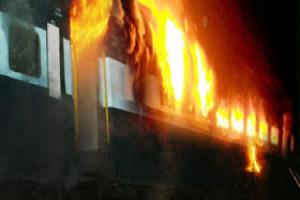
However passengers tend to carry inflammable and dangerous materials like firecrackers, petroleum products, explosives etc., resulting in fire accidents and loss of human life.
Suggest solutions for reducing fire accidents due to carrying of inflammable materials by passengers.